InsightfulPM

The Executive Intelligence Layer Your Portfolio Is Missing
Introduction to a top-down intelligence flow - Portfolio Execution Score.
Praful Pujar
3/31/20262 min read
Last week I wrote about the Interpretation Tax — the cost of decoding data instead of making decisions. Today I want to show you what closing that gap actually looks like.
Not conceptually. Structurally.
A CxO should never have to start with raw metrics. They should start with two fundamental questions:
Is my portfolio structurally healthy? (The Destination)
Is my engine operationally efficient? (The Power)
The answer lies in the Executive Intelligence Layer—a unified framework where InsightfulPM-AI (Portfolio) and Utilization Insights (Resources) work in tandem.
Pillar 1: The Portfolio Signal (InsightfulPM-AI)
The executive anchor here is the PES (Portfolio Execution Score). It is one number—a composite structural health signal across the entire portfolio.
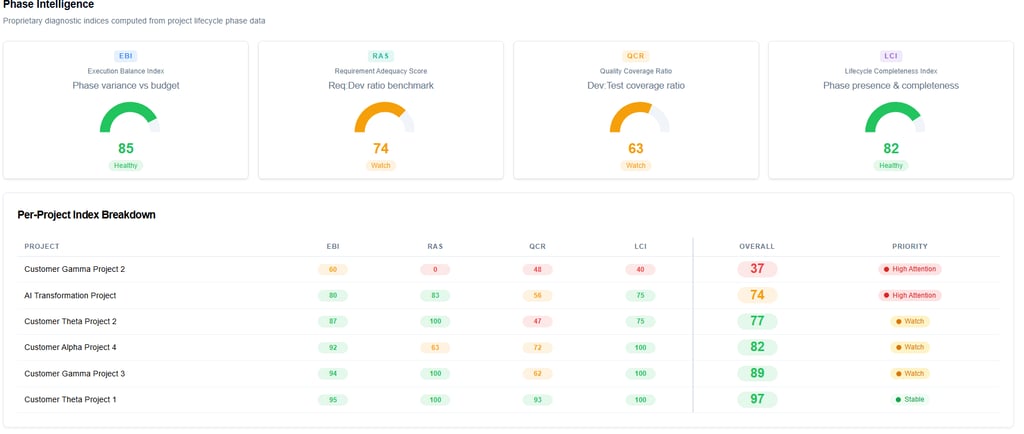
When PES signals risk, we drill down into four structural indices to find the root cause:
EBI (Execution Balance Index): Is effort distributed correctly across phases?
RAS (Requirement Adequacy Score): Did we define the problem well enough before building?
QCR (Quality Coverage Ratio): Is testing proportionate to development?
LCI (Lifecycle Completion Index): Are programmes progressing through the lifecycle correctly?
Pillar 2: The Operational Signal (Utilization Insights)
A healthy portfolio score is unsustainable if the engine is leaking capacity. Utilization Insights provides the intelligence needed to ensure your workforce is actually converting into productive output.
We look for the Capacity Leakage Signal. Execution failures are often the result of "Structural Delivery Bottlenecks" that traditional HR or finance reports miss. We diagnose this through:
CLI (Capacity Leakage Index): Identifies where workforce potential is misaligned and not converting into productive output.
RBI (Role Balance Index) : Reveals where specific roles (e.g., Architects vs. Developers) are out of sync, preventing the organization from scaling.
ACI (Allocation Conformance Index): Reveals what percentage of your workforce is working close to their planned allocation — not too much, not too little.
CII (Capacity Idle Index) – Reveals What percentage of your total workforce capacity is sitting completely idle — not allocated or not working.
The Bridge: Connecting Finance to Delivery
The true power of the Executive Intelligence Layer is that it bridges the "Language Barrier" within the C-Suite.
Typically, Delivery speaks in milestones, while Finance speaks in margins. These indices create a common language:
Predictive Margin: A low QCR (Quality) or low RAS (Requirements) predicts a margin hit months before it shows up in the P&L.
Productive Payroll: The Capacity Leakage Index tells Finance exactly how effectively payroll is being converted into portfolio value.
This shift redefines how organizations are managed. Instead of tracking isolated, bottom-up indicators, leadership interprets interconnected signals that reflect both execution behavior and systemic financial risk.
The Leadership Imperative
As transformation complexity grows, one question becomes central: Do we merely track execution — or do we understand its implications early enough to act?
For organisations delivering large-scale transformation programmes, the cost of interpretation delay is material. Small signals in resource imbalance or requirement gaps compound into financial impact, customer risk, and strategic drift. Execution Intelligence is not a software feature. It is an operating discipline. InsightfulPM-AI and Utilization Insights exist to operationalise this discipline at scale.
Because in complex transformations - Visibility informs. Interpretation leads.
If this resonates with how your organisation manages transformation risk, we'd welcome a conversation