InsightfulPM

The Execution Intelligence Model
Bridging Strategy and Reality in Large-Scale Digital TransformationsBlog post description.
Praful Pujar
3/4/20264 min read
The Execution Intelligence Model™
Bridging Strategy and Reality in Large-Scale Digital Transformations
In large-scale digital transformations, the most expensive gap is not in planning — it is between what leadership believes is happening and what execution reality is signaling.
An organization approves a $50M transformation program. The strategy is clear. The roadmap is defined. Funding is committed.
Months later, cost forecasts drift. Dependencies surface that were not visible at approval. Resource strain intensifies. Vendor milestones begin to slip. Strategic priorities shift — but execution remains committed to the original scope. This is not a failure of planning.
It is a failure of interpretation.
Enterprise performance rarely collapses suddenly. Instead, it erodes through small execution signals that accumulate across projects, vendors, resource allocations, and technical dependencies — long before financial impact becomes visible in quarterly reviews. The challenge facing modern executives is not a lack of data.
It is interpretation delay — the time between when a signal emerges in execution and when its strategic or financial meaning is understood.
The Structural Gap: Where Transformation Value Erodes
Large-scale transformations rarely fail because of a single catastrophic decision. They drift because signals emerge in one layer and are interpreted too late in another. Consider a common pattern across enterprise programs:
Month 1: Strategy is confirmed. Investment is approved. Alignment appears strong.
Month 2: Delivery uncovers a critical technical dependency. Two workstreams are now linked more tightly than originally modeled. The schedule impact is noted but viewed as manageable.
Month 3: A specialized skill constraint surfaces. Resource reallocation begins. Cost per unit of delivery increases subtly, but no financial alarm is triggered.
Month 4: Vendor commitments adjust due to external factors. Milestones shift slightly. Each adjustment seems operational, not strategic.
Month 5: Customer priorities evolve. Scope changes incrementally. Execution absorbs them to maintain momentum.
Month 6: Delivery teams begin compensating through overtime, reprioritization, and internal trade-offs. Variance exists — but across different reporting systems.
Month 7: Financial review reveals forecast deviation. Margins tighten. Schedule confidence weakens.
Month 8: Leadership convenes to understand why performance diverged from expectations.
By this stage, the organization is no longer interpreting signals — it is managing consequences. Nothing in this sequence represents poor leadership or weak execution.
Each signal was rational in isolation.
The erosion occurred in the intervals between signals — where no single system connected operational behavior to financial and strategic meaning. That interval is interpretation delay. And in complex transformations, interpretation delay is expensive.
Why Traditional Systems Fall Short
Modern enterprises have invested heavily in visibility:
Portfolio systems track initiatives and strategy
Delivery platforms capture schedule, scope, and dependencies
Financial tools monitor cost and variance
Resource systems manage capacity and allocation
Yet these systems typically operate in layers:
Strategy Layer defines priorities and investment allocation
Delivery Layer tracks execution progress and constraints
Finance Layer reports outcomes and variance
Leadership Layer intervenes based on reported results
Enterprise performance, however, does not emerge from layers. It emerges from the interaction between layers. When those interactions are not continuously interpreted, small execution deviations compound silently. What appears operationally manageable becomes financially material over time.
Visibility alone is insufficient.
Interpretation must be continuous.
The Execution Intelligence Model™
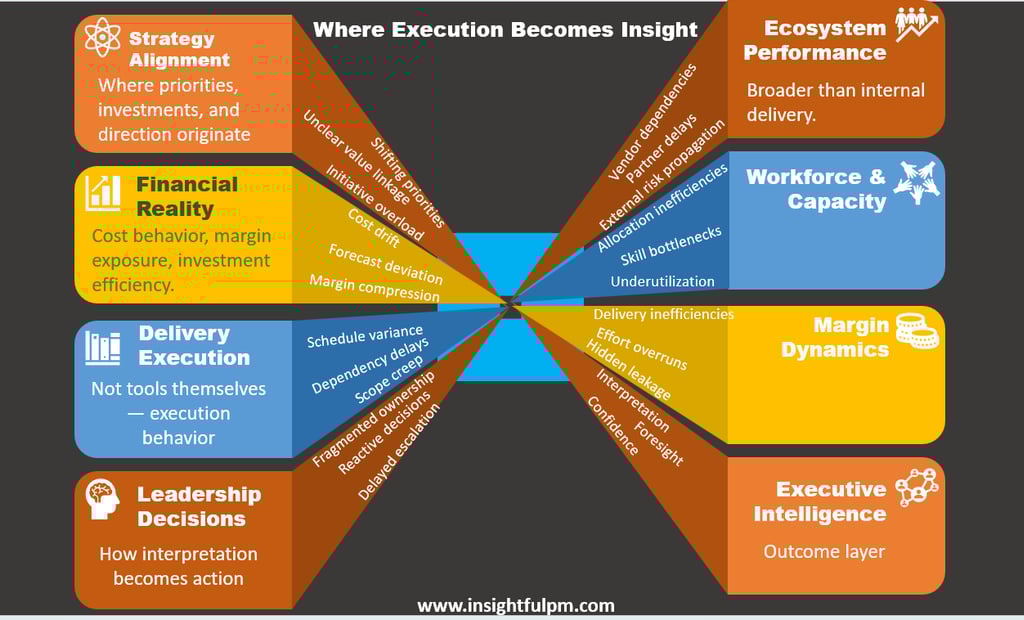
The Execution Intelligence Model™ is a structural framework that explains how operational signals move across strategy, execution, finance, and leadership — and how interpretation delay creates measurable enterprise impact. It recognizes that transformation performance emerges from eight interconnected dimensions:
Strategy Alignment: Where priorities and investment decisions originate. Misalignment here later manifests as resource strain, scope volatility, and cost overruns.
Delivery Execution: How initiatives progress operationally. Dependency friction, schedule variance, and bottlenecks generate early indicators of downstream impact.
Workforce & Capacity: How talent is allocated and utilized. Skill bottlenecks and underutilization influence cost structures before margin compression becomes visible.
Ecosystem Performance: Vendor and partner dynamics. External dependencies introduce risk signals that often remain isolated within supplier management systems.
Financial Reality: Cost behavior and forecasting accuracy. Financial reporting reflects outcomes, but frequently lags the operational behaviors driving them.
Margin Dynamics: Where execution behavior translates into economic performance. Small inefficiencies across multiple programs aggregate into material profitability impact.
Leadership Decisions: How signals are interpreted and acted upon. Delayed escalation or fragmented ownership amplifies execution drift.
Executive Intelligence: The converging layer where signals become foresight. This is where continuous interpretation transforms operational noise into strategic clarity.
These dimensions do not operate independently. They amplify or dampen one another depending on how quickly signals move between them.
From Reporting to Continuous Interpretation
Traditional enterprise systems are designed to report status. They answer:
What happened?
Where are we today?
What changed?
Execution Intelligence is designed to interpret meaning. It answers:
Why is this happening?
What does it mean for cost, schedule, and strategic outcomes?
Where will this lead if it remains unaddressed?
For CEOs, this improves strategic confidence. You understand the real health of transformation initiatives, not just reported status.
For CFOs, it strengthens margin protection and forecast integrity. You identify cost drivers and deviations weeks before they appear in financial close.
For CDOs and CIOs, it connects transformation initiatives to measurable business outcomes. You understand how delivery reality is shaping strategic impact.
For CROs, it reveals how execution friction influences revenue realization. You see how technical delays, resource constraints, and vendor dynamics affect customer commitments.
For COOs, it provides early visibility into operational strain before it escalates. You can intervene with precision rather than urgency.
Interpretation Is the New Control Layer
In earlier eras of enterprise management, control came from process discipline and reporting rigor. In complex digital transformations, control comes from interpretation speed. Organizations that shorten the distance between signal and decision outperform those that simply report more frequently.
Execution Intelligence is not about seeing more.It is about understanding sooner.
The AI Opportunity: From Retrospective to Predictive
Much of today’s enterprise AI conversation focuses on automation — faster reporting, smarter workflows, predictive alerts. The deeper opportunity is structural, not technological. AI becomes transformative when it reduces interpretation delay — when it connects execution signals to financial and strategic meaning continuously, not retrospectively. Instead of waiting for quarterly outcomes, leadership gains awareness of how today’s execution reality is shaping tomorrow’s results. This is not about more dashboards. It is about decision-ready clarity.
A Shift in Enterprise Operating Philosophy
The Execution Intelligence Model™ does not replace existing strategy, delivery, or financial systems.It operates above them — creating coherence across how signals move through the organization. Modern transformations are complex ecosystems. Performance emerges from interactions, not isolated metrics. In such environments, competitive advantage shifts:
From visibility to interpretation.
From monitoring to meaning.
From reaction to foresight.
The Leadership Imperative
As transformation complexity grows, one question becomes central. Do we merely track execution — or do we understand its implications early enough to act?
For organizations delivering large-scale transformation programs, the cost of interpretation delay is material. Small signals compound into financial impact, customer risk, and strategic drift.
Execution Intelligence is not a software feature or a consulting overlay. It is an operating discipline. InsightfulPM exists to operationalize this discipline at scale. Because in complex transformations, visibility informs,
Interpretation leads.