InsightfulPM
The Next Evolution of Portfolio Management
Adding Executive Intelligence Without Disrupting Operations
Praful Pujar
6/8/20265 min read
The Next Evolution of Portfolio Management: Adding Executive Intelligence Without Disrupting Operations
Modern and even traditional organizations already have project management tools, PMO processes, executive dashboards, resource management systems, financial reporting platforms, and collaboration tools. Yet leadership teams continue to spend significant time reviewing reports, reconciling conflicting signals, and determining where intervention is actually required.
The issue is not a lack of data. The issue is the Interpretation Tax organizations pay every day—the cost of transforming disconnected operational signals into meaningful "Executive Decisions".
At its core, this tax exists because organizations have abundant data but lack a layer of Executive Intelligence capable of interpreting what those signals mean for delivery, customers, revenue, risk, and business outcomes.
The issue is that most operational systems were designed to record activity, not generate executive intelligence.
As organizations become increasingly complex, the next evolution of portfolio management is not about collecting more information. It is about transforming existing operational signals into actionable executive insight—without disrupting existing systems, processes, or investments.
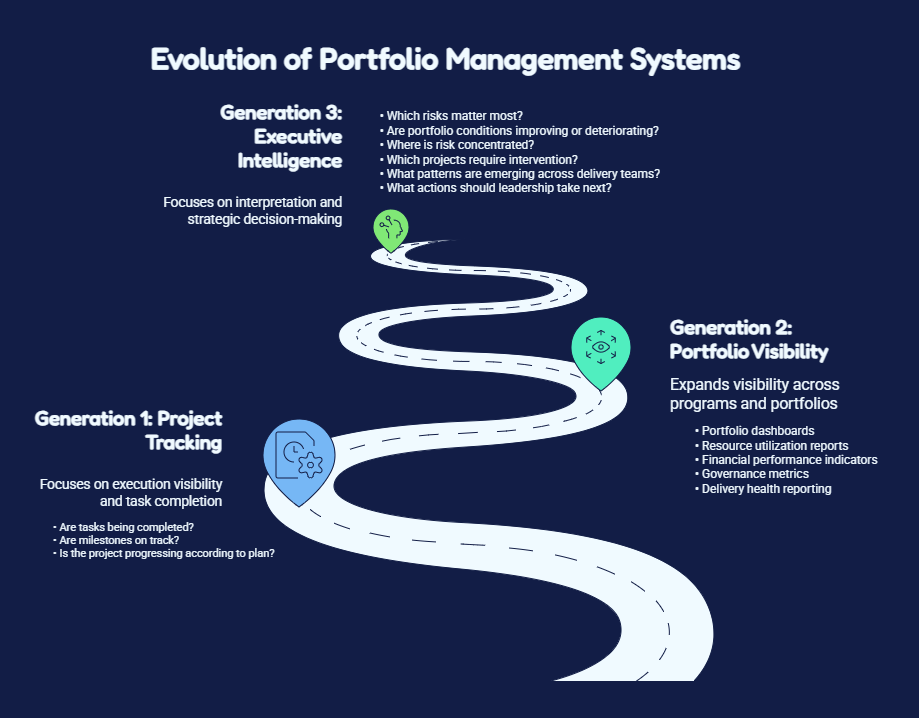
Every Generation of Portfolio Management Solved a Different Problem
Generation 1: Project Tracking
The first generation focused on execution visibility. Organizations needed answers to questions such as:
Are tasks being completed?
Are milestones on track?
Is the project progressing according to plan?
Project management systems successfully solved this challenge.
Generation 2: Portfolio Visibility
The next evolution expanded visibility across programs and portfolios.
Organizations gained access to:
Portfolio dashboards
Resource utilization reports
Financial performance indicators
Governance metrics
Delivery health reporting
These capabilities answered an important question:
What is happening across the portfolio?
This is where many organizations operate today.
Generation 3: Executive Intelligence
The next evolution focuses on interpretation. Leadership teams increasingly need answers to questions such as:
Which risks matter most?
Are portfolio conditions improving or deteriorating?
Where is risk concentrated?
Which projects require intervention?
What patterns are emerging across delivery teams?
What actions should leadership take next?
These questions cannot be answered through dashboards alone. They require intelligence.
Why Traditional Dashboards Are Reaching Their Limits
Traditional reporting systems are highly effective at presenting information.
They can tell leaders:
Which projects are delayed
Which initiatives are over budget
Which milestones have been missed
Which teams are overallocated
However, executives rarely struggle to find data. They struggle to interpret it.
A dashboard may show:
Three projects with quality concerns
Two programs with declining delivery performance
One strategic initiative missing key milestones
But it rarely explains:
Whether these signals are connected
Which issue poses the greatest business risk
Whether conditions are improving or worsening
What intervention is likely to produce the greatest impact
Visibility is valuable.
Interpretation is transformational.
Executive Decisions Require More Than Project Metrics
Traditional portfolio reporting focuses heavily on delivery indicators such as schedule variance, budget performance, milestone completion, and resource utilization.
While these signals remain important, they represent only one dimension of organizational performance.
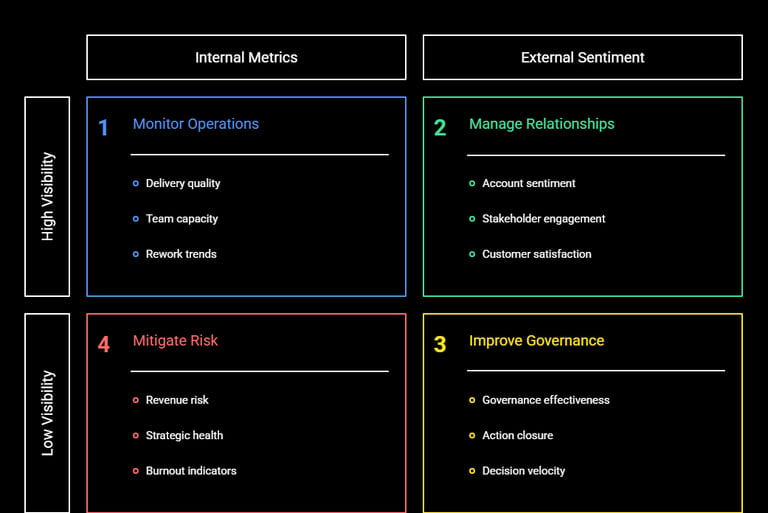
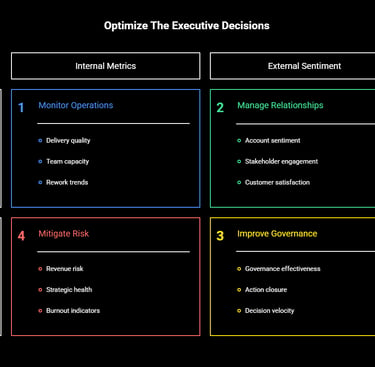
Executive decisions are influenced by a much broader set of signals, including:
Customer satisfaction and account sentiment
Executive stakeholder engagement
Strategic account health
Revenue realization risk
Team capacity and burnout indicators
Governance effectiveness
Delivery quality and rework trends
Decision velocity across programs
Meeting outcomes and action closure patterns
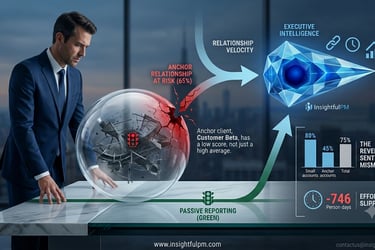
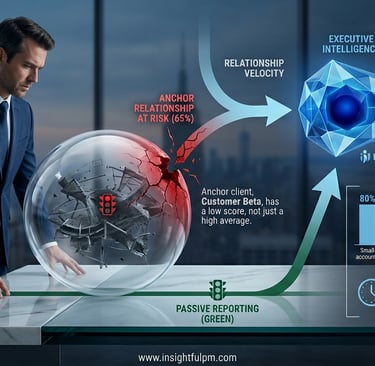
A project may appear green on a dashboard while customer sentiment is deteriorating.
A program may be delivering on schedule while executive stakeholders are losing confidence.
A portfolio may be meeting financial targets while quality issues are quietly creating future revenue exposure.
These signals often exist in separate systems and are rarely interpreted together.
Executive Intelligence brings them together into a single interpretation layer, helping leaders understand not just what is happening, but what it means for customers, revenue, relationships, execution outcomes, and strategic objectives.
Executive Intelligence Is Not Another Dashboard
One of the biggest misconceptions is that Executive Intelligence means adding another reporting tool.
It does not.
Executive Intelligence sits above existing operational systems. It consumes signals from:
Project and portfolio management platforms
Resource management systems
Financial systems
Delivery and engineering tools
Meeting intelligence platforms
Customer satisfaction data
Operational reporting systems
It then transforms those signals into leadership-ready insight. Organizations do not need to replace existing investments. They need to unlock more value from them.
From Data to Decisions
The difference between traditional reporting and Executive Intelligence is significant.
Traditional Reporting - >Executive Intelligence
Status Updates -> Portfolio Narratives
KPI Tracking -> Pattern Detection
Project Health-> Risk Concentration
Historical Reporting -> Trend Intelligence
Customer Surveys-> Relationship Intelligence
Meeting Notes-> Decision Intelligence
Delivery Metrics-> Outcome Intelligence
Metrics-> Executive Recommendations
The goal is not more reporting. The goal is better decisions.
The Rise of Longitudinal Intelligence
The most valuable insights rarely come from a single report.
They emerge over time.
Organizations increasingly need to understand:
Which conditions are improving?
Which risks are recurring?
Which delivery patterns are becoming systemic?
Where execution maturity is increasing or declining?
Which customer accounts are becoming vulnerable?
Which operational issues repeatedly impact outcomes?
This requires organizational memory. A capability most dashboards were never designed to provide.
Longitudinal Intelligence enables leaders to move beyond monitoring execution and begin understanding execution behavior.
The Future Is an Executive Intelligence Layer
The next evolution of portfolio management is not another PMO process.
It is not another dashboard.
It is not another reporting tool.
It is an Executive Intelligence layer that sits above existing operational systems and continuously answers three critical questions:
Where are we today?
Understanding current portfolio health, business risk, customer sentiment, and execution posture.
Which direction are we moving?
Identifying trends, emerging risks, improving capabilities, and deteriorating conditions before they become critical.
What should leadership do next?
Providing actionable recommendations based on interpreted organizational signals.
Organizations that embrace this approach will spend less time interpreting reports and more time making informed decisions.
Closing Thought
For years, portfolio management focused on capturing execution data.
The next evolution is helping leaders understand what that data means.
Organizations do not need to disrupt operations to achieve this shift. They do not need to replace their PMO, project management platforms, reporting systems, or operational processes.
What they need is an Executive Intelligence layer that transforms existing operational signals into strategic insight, organizational learning, and actionable leadership guidance.
The ability to identify risk concentration, interpret execution patterns, monitor customer sentiment, connect delivery performance with business outcomes, and provide executive recommendations has traditionally required significant manual effort from PMOs, delivery leaders, customer success teams, and executive leadership.
If you believe such a capability sounds aspirational or years away, it isn't.
It exists today.
At InsightfulPM-AI, we have been building exactly this vision—an Executive Intelligence layer that sits above existing operational systems, analyzes portfolio, delivery, customer, and operational signals, and helps leadership teams answer three critical questions:
Where are we today?
Which direction are we moving?
What should we do next?
The future of portfolio management is not more dashboards. It is better interpretation, stronger organizational memory, richer executive intelligence, and smarter decisions. And that future has already begun.
If your organization is struggling to connect delivery signals, customer outcomes, and executive decision-making, it may be time to explore what an Executive Intelligence layer can do.
Reach out to us at contactus@insightfulpm.com to discuss how InsightfulPM-AI can help transform operational data into executive intelligence.